How the Coast Eats
Seaside dining has its own social contracts. Rules governing when to order, which utensils to ignore, and how to treat fish bones are neither arbitrary nor snobbish; they are practical guardrails preserving the clean flavour of wild fish and the dignity of the cook.
The Absolute Ban on Cheese
Requesting grated Parmigiano-Reggiano or Pecorino over a bowl of spaghetti alle vongole (clams) or risotto ai frutti di mare is considered an egregious culinary error throughout Italy. The intense, aged umami and fat of cow or sheep cheese coats the tongue, obliterating the delicate, briny sweetness of freshly opened bivalves.
Instead, Italian seaside cooks rely on "mollica atturrata"—stale breadcrumbs toasted crisp in olive oil with garlic, anchovy paste, or wild fennel—to provide texture and richness without overwhelming delicate seafood.
The Honour of the Clean Plate
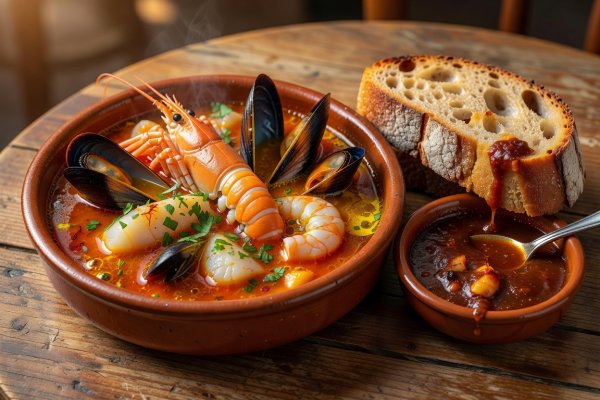
Leaving emulsified fish broth on a plate is viewed as an insult to the kitchen. In Italy, the gesture is called fare la scarpetta ("making the little shoe"); in Spain, it is rebañar el plato; in France, saucer le plat.
Using a torn piece of crusty sourdough held between thumb and forefinger to mop every trace of saffron cooking juice, garlic-parsley oil, or wine sauce is the universal coastal compliment. Cutlery is set aside during this ritual.
Navigating the Spanish Coastal Bar
In maritime Galicia, Andalusia, and the Basque Country, eating seafood is rarely a formal three-course seated dinner. It is an ambulatory group sport guided by strict portion definitions.
The Single Bite
Consumed standing at the bar with a small draught beer (caña) or cider. A single anchovy skewered with an olive and guindilla pepper (the Gilda) or a spoonful of ensaladilla de marisco.
The Tasting Share
Ideal for two diners. Half-plates of fried baby squid (chipirones), steamed razor clams (navajas), or padrón peppers acting as counterpoint to rich fried fish.
The Communal Centrepiece
Full platters placed strictly in the middle of the table. No one orders individual main courses; forks enter the central dish collectively until the shell heap is cleared.
The Respect of the Skeletal Frame
When presented with a whole grilled sea bass, turbot, or bream, following traditional coastal mechanics preserves both elegance and flavour:
-
Never Flip the Fish
Old superstition across North Sea and Mediterranean ports warns that turning a fish over at the table capsizes a fishing boat at sea. Practically, flipping breaks the spine and distributes small needle bones throughout the lower fillet. Instead, eat the top fillet first, gently lift the entire spinal bone from tail to neck with a fork, set it on the side plate, and proceed to the bottom fillet cleanly.
-
The Delicacies for the Discerning
The prized bites are not the thickest meat of the flank. Mediterranean and Atlantic connoisseurs prize the cheek (guanciale / cocochas), the gelatinous head cartilage, and the fatty belly flaps (ventresca).