Ports Worth Understanding
The culinary weight of a port city is rarely determined by its size. Instead, it is governed by bathymetry, the distance fishing vessels must travel before hitting oceanic drops, and whether dockworkers still dictate where fish is sold.
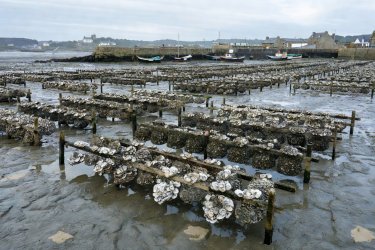
Cancale: The Tidal Basin of the Oyster
Perched on the Emerald Coast of Ille-et-Vilaine, Cancale commands the western wing of the Baie du Mont-Saint-Michel. Here, tides surge up to 14 metres vertically—among the strongest in the world. The constant movement pushes plankton over thousands of hectares of iron racks.
Visitors eat standing on the granite sea wall of La Houle. Local shuckers pry open hollow cupped oysters (Crassostrea gigas) and flat Belons (Ostrea edulis), discard shells directly onto the pebble foreshore below, and serve them strictly with a quarter lemon or salted butter on sourdough.
Getaria: The Charcoal Grill of Biscay
Getaria sits on a narrow isthmus jutting into the Cantabrian Sea beneath Mount San Antón (known locally as El Ratón). Its deep water harbour sheltered Basque whalers for half a millennium. Today, its culinary identity is rooted in an elemental tool: the outdoor besuguera, a double-wire fish clamp laid across smouldering holm oak embers.
The whole rodaballo (turbot) is roasted intact with its gelatinous skin and cartilage, basted with olive oil and txakoli—the bone-dry, spritzy green Basque white wine grown on steep hillside terraces just above the dock.
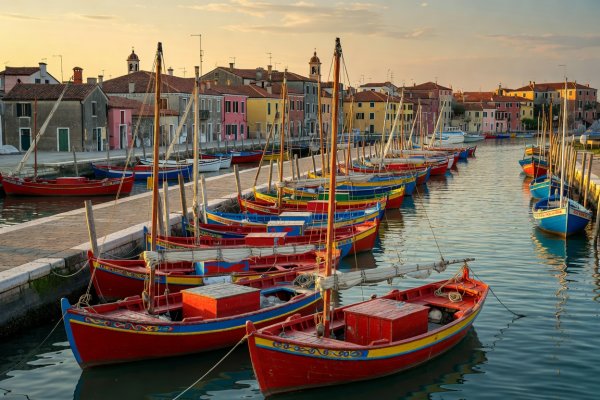
Chioggia: The Working Heart of the Venetian Lagoon
While Venice welcomes cruise ships, southern neighbour Chioggia remains a blue-collar fishing powerhouse. Its canal grid mirrors Venice, yet the Riva Vena is packed with working trabaccoli and bragozzi fishing trawlers.
Chioggia's kitchen is defined by lagoon creatures: moeche (seasonal soft-shell green crabs fried crisp), granseola (spider crab pulled apart and seasoned with lemon), and sarde in saor—sardines fried and preserved in sweet-and-sour vinegar, caramelized onions, pine nuts, and raisins.
Matosinhos: The Street Brazier Capital
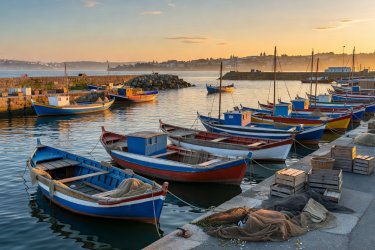
Bordering Porto where the Leça river meets the cold North Atlantic, Matosinhos is wrapped around the Porto de Leixões. Walking along Rua Heróis de França means walking through clouds of grey aromatic woodsmoke.
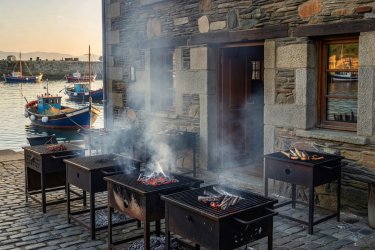
Taverns place metal barbecues directly on the pavement. Whole sardinhas, robalo (sea bass), and polvo (octopus) are buried in coarse mineral sea salt from Aveiro and grilled over eucalyptus embers without spices, sauces, or fillets.
Coastal Harbour Comparison
A reference overview of water bodies, signature wild harvests, and the traditional dockside heating techniques.
| Harbour Town | Sea Basin | Key Species | Primary Cooking Technique | Traditional Wine Pairing |
|---|---|---|---|---|
| Cancale (France) | English Channel | Belon & Hollow Oysters | Served Raw / Shucked Live | Muscadet Sèvre-et-Maine |
| Getaria (Spain) | Bay of Biscay | Wild Turbot, Anchovies | Besuguera over Wood Embers | Getariako Txakolina |
| Chioggia (Italy) | Northern Adriatic | Moeche Soft Crabs, Cuttlefish | Deep-Fried, Saor Preservation | Soave Classico |
| Matosinhos (Portugal) | North Atlantic | Fat Sardines, Sea Bass | Coarse Salt Street Braziers | Vinho Verde Loureiro |
| Bergen (Norway) | North Sea & Fjords | Stockfish, King Crab, Trout | Brining, Cold Oak Smoking | Dry Norwegian Cider |